
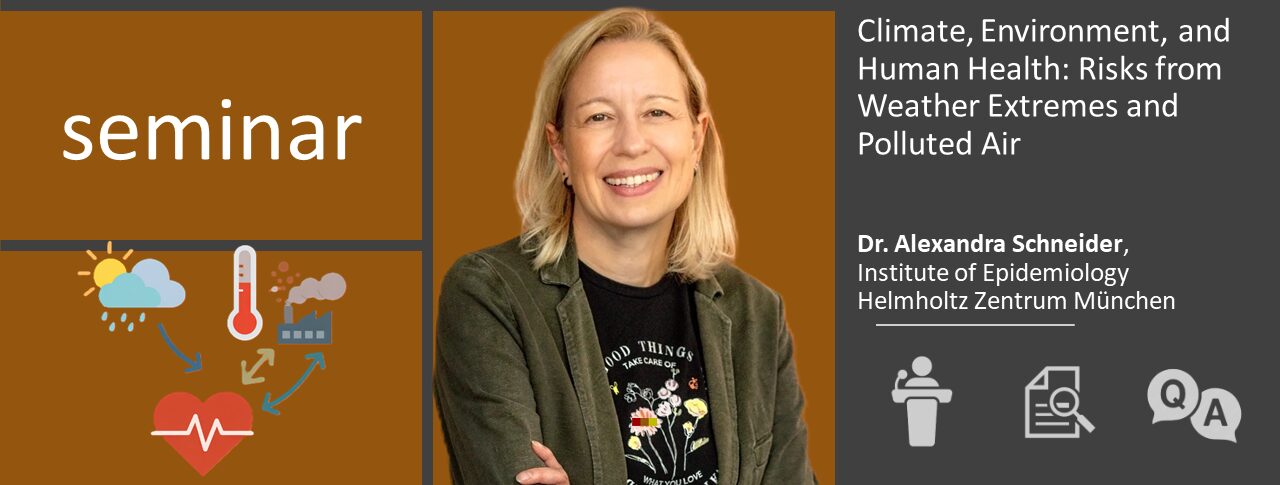
Climate, Environment, and Human Health: Risks from Weather Extremes and Polluted Air
5 March 2026, 14.00–15.00 CET
Hybrid event — Geocentrum, Uppsala University & Zoom
About
Extreme weather and environmental exposures are key drivers of disease burden in populations worldwide. In this seminar, Dr. Alexandra Schneider — Deputy Director of the Institute of Epidemiology at Helmholtz Zentrum München — will explore how weather extremes (heat, cold, heavy rain) and environmental factors like air pollution, noise, and urban built environments affect human health, with an emphasis on cardiovascular, metabolic and respiratory outcomes. Drawing on her work leading the Environmental Risks research group, the talk will highlight evidence on temperature–health relationships, exposure–response functions, vulnerable subgroups, and synergistic effects of pollutants with heat. The seminar will discuss both acute (short‑term) and chronic (long‑term) health impacts, and implications for adaptation and public health strategies in a changing climate.
Key Topics
- Weather extremes and health: heat, cold, heavy rainfall risks
- Air pollution, noise, and urban climate influences on disease
- Cardiovascular and metabolic outcomes linked to environmental exposures
- Exposure–response relationships and susceptible populations
- Synergies between climate, air quality, and social determinants of health
- Implications for adaptation, early warning and public health protections
Speaker
Alexandra Schneider, MPH, PhD
Deputy Director, Institute of Epidemiology, Helmholtz Zentrum München — German Research Center for Environmental Health.
Alexandra Schneider is a senior epidemiologist and Deputy Director of the Institute of Epidemiology at Helmholtz Zentrum München. Since 2010 she has led the Environmental Risks research group, investigating how weather, climate change, air pollution, noise and urban environments influence population health — particularly cardiovascular, metabolic and other chronic diseases. Her interdisciplinary work combines environmental science, meteorology and epidemiological methods to generate evidence for interventions and public health protection in the face of climate and environmental stressors. Schneider holds a Diploma in Meteorology, a Master’s in Public Health and a PhD in Human Biology and is active in international collaborations on environmental health.
View bio: https://www.helmholtz-munich.de/en/epi/alexandra-schneider
Highlights
- Insights into health impacts of climate and environmental stressors
- Evidence on interactions between air pollution, heat and disease
- Discussion of vulnerable groups and adaptation strategies
- Q&A dialogue with participants