
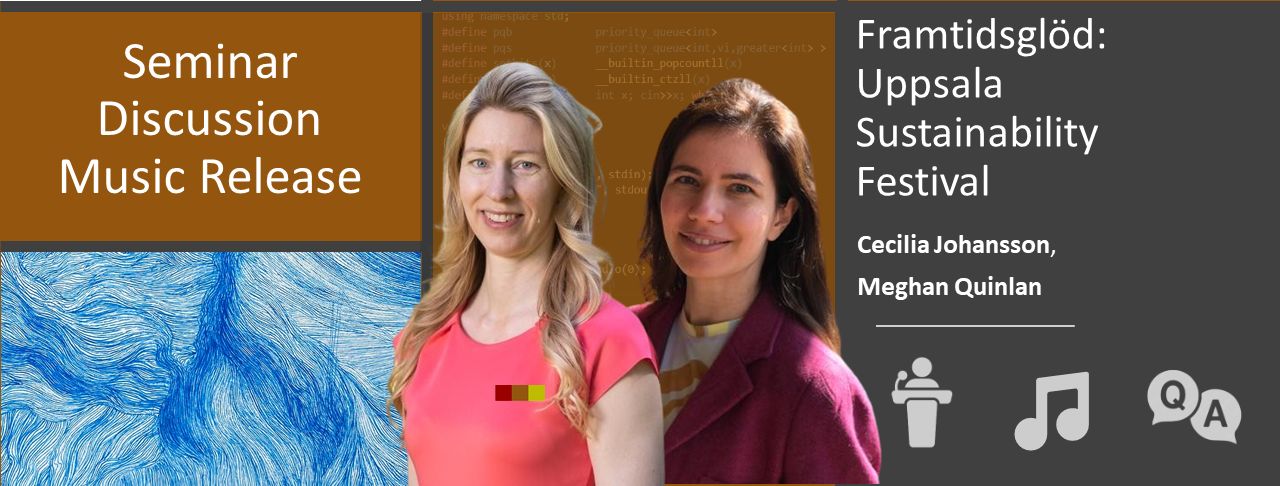
Climes @ Framtidsglöd – Uppsala Sustainability Festival 2024
Info in English
climes at Framtidsglöd – Sustainability Festival 2024
(The event will be held in Swedish. Info in Swedish follows)
On November 30, climes took part in Framtidsglöd – Sustainability Festival at Uppsala Concert and Congress Hall, an event that highlights sustainability through science, culture, and innovation. The festival gathered researchers, artists, and the public to inspire a sustainable future.
climes Program:
- 12:30 – 13:20:
Lecture: Extreme Weather and Societal Impacts
Cecilia Johansson, Senior Lecturer i Meteorology, at Uppsala University delivered an engaging lecture on how extreme weather events are defined, their increasing frequency, and their societal effects, using examples from Sweden and around the world. - 13:30 – 14:30:
Release of “Weather the Storm”
Composer Meghan Quinlan presented her musical piece, inspired by climate data from climes researchers. The performance was followed by a panel discussion on the theme “Art and Science: Exploring Creative Expressions Inspired by Scientific Research”.- Panel Participants:
- Meghan Quinlan – Composer and Researcher
- Ingela Lanekoff – Centre for Chemical Mechanisms of Life
- Fredrika Gullfot – Musician and Researcher
- Mattias Lundberg – Professor of Musicology
- Moderator: Elin Inge, Postdoctor in Public Health, with experience in integrating art and science, particularly focusing on health promotion initiatives through creative projects
- Read full narrative of the panel discussion below.
- Panel Participants:
Read more about the festival and see the full program here: https://barnombudet.se/framtidsglod/.
Artwork by Cecilia Enberg
Info på svenska
climes på Framtidsglöd – Hållbarhetsfestival 2024
Den 30 november deltog climes i Framtidsglöd – Hållbarhetsfestival på Uppsala Konsert och Kongress, ett evenemang som sätter fokus på hållbarhet genom vetenskap, kultur och innovation. Festivalen samlar forskare, konstnärer och allmänheten för att inspirera till en hållbar framtid.
Program för climes:
- 12.30 – 13.20:
Föreläsning: Extremt väder och samhällskonsekvenser
Cecilia Johansson, universitetslektor i meteorologi vid Uppsala Universitet, håller en engagerande föreläsning om hur extrema väderhändelser definieras, deras ökade frekvens och påverkan på samhället, med exempel från Sverige och världen. - 13.30 – 14.30:
Release av “Weather the Storm”
Kompositören Meghan Quinlan presenterar sitt musikaliska verk, inspirerat av klimatdata från forskare vid climes. Framträdandet följs av ett panelsamtal med temat “Konst och Vetenskap: Utforskning av kreativa uttryck inspirerade av vetenskaplig forskning”.- Deltagare i panelen:
- Meghan Quinlan – Kompositör och forskare
- Ingela Lanekoff – Centre for Chemical Mechanisms of Life
- Fredrika Gullfot – Musiker och forskare
- Mattias Lundberg – Professor i musikvetenskap
- Moderator: Elin Inge – Postdoktor i folkhälsa, med erfarenhet inom arbete som förenar konst och vetenskap, särskilt med fokus på hälsofrämjande insatser genom kreativa projekt
- Deltagare i panelen:
Läs mer om festivalen och hela programmet här: https://barnombudet.se/framtidsglod/.
Konstverk av Cecilia Enberg
Narrative of the panel discussion:
Introduction
The session began with a warm welcome from the moderator, who introduced the themes of the panel: the interplay between art and science, and how these two worlds can collaborate and enrich each other. The event was framed around the release of “Weather the Storm”, a composition by Meghan Quinlan inspired by climate data.
Meghan’s presentation set the stage with an explanation of her piece. She described how the composition uses historical climate data—daily weather forecasts from the winters of 1959 to 2021 in the Atlantic region of the USA. The data was transformed into a sonic narrative, where each minute of music represents ten years. Meghan emphasized the connection between human and environmental systems, using vocal samples and stochastic processes to convey the growing complexity of climate change over time. She noted, “Every breath we take connects us to the atmosphere, and this piece is a human response to the Earth’s changes.”
Panelist Introductions
The panel included:
- Meghan Quinlan: Composer of “Weather the Storm” and a researcher in musicology.
- Ingela Lanekoff: Professor in analytical chemistry at Uppsala University.
- Fredrika Gullfot: Musician and former biotech entrepreneur, now creating music inspired by cellular communication.
- Mattias Lundberg: Professor of musicology, known for his work on the intersection of music and academia.
- Anna Haglund: Sound artist whose work often explores participatory and research-based processes.
The moderator, Elin Inge, guided the discussion with her background in public health and her interest in collaborative research and art.
Exploring the Connection Between Art and Science
The discussion highlighted how art and science serve as complementary methods for understanding reality. Science employs structured methodologies to uncover how systems work, while art explores intuitive and emotional dimensions. The interplay between objectivity and subjectivity was examined as an essential part of the human experience.
One panelist described a transition from green innovation and biotechnology to music creation, blending scientific understanding with artistic expression, including the use of cellular communication patterns in their work. The shared goal of art and science—to make sense of the world through distinct approaches—was emphasized.
Another panelist brought a philosophical lens, referencing concepts of “worldmaking,” where both disciplines construct unique interpretations of reality. The abstract nature of music was discussed as a way to represent complex phenomena such as storms or molecular structures.
Interdisciplinary Collaboration
Parallels between the processes in art and science were explored, focusing on the transformation of ideas into tangible outputs. Examples were shared of how visualizing molecular data often involves creative techniques to enhance understanding. Collaborative opportunities, such as integrating artistic perspectives into scientific visualizations, were suggested as ways to make data more accessible and engaging.
The mutual inspiration from interdisciplinary collaboration was discussed, with conversations between artists and scientists often leading to new ideas for both fields. The value of dialogue in fostering creativity and innovation was highlighted, alongside a cautionary note about maintaining the autonomy of art as a form of inquiry. Historical examples were shared to illustrate how artistic experiments can transcend their scientific origins to reveal broader truths.
Challenges and Opportunities
Challenges in integrating art and science included the tendency to view art as merely a tool for communicating scientific findings. The need for granting artists creative freedom in collaborations was stressed, encouraging interpretation and expansion of scientific ideas in unexpected ways.
Suggestions included immersive experiences, such as artists working directly in scientific labs to explore materials and processes, which could inspire novel approaches and shared insights. The use of metaphors and abstraction was noted as a common thread between art and science, particularly in communicating complex topics to broader audiences. The role of the artistic process in revealing the existential dimensions of science was also explored, adding emotional depth to technical narratives.
Conclusion
The session concluded with a shared recognition of the potential for art and science to inspire and enhance each other. The importance of creating more opportunities for these intersections—through residencies, collaborative projects, and informal exchanges—was underscored. The panelists expressed enthusiasm for the creative synergy demonstrated during the session, with hopes for continued dialogue and collaboration between disciplines.